



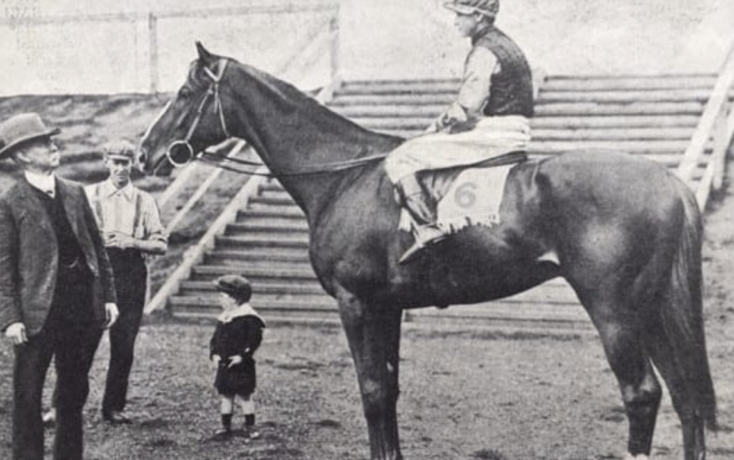
 Mountain King is one of the best race horses you may never have heard of
Everyone knows the stories of the greats of the turf, the deeds of Phar Lap, Tulloch, Winx, Black Caviar, Manikato, Makybe Diva, Carbine, Bernborough and Kingston Town firmly etched in the minds of racing fans.
But there are plenty of horses whose achievements go unheralded. We take a look at three outstanding gallopers you may not have heard of…

MOUNTAIN KING
1904 chestnut stallion
Wallace – Bonnie Rosette
A son of Carbine’s high class first crop son Wallace (Australian Champion Sire 1915/16), Mountain King was bred and raced by Scottish immigrant John McDonald who, in the late 1890s began to purchase well related broodmares for his Mungie Bundie Stud in the Moree Plains of New South Wales.
One of those mares, secured from the St Albans Stud dispersal in 1900, was the imported Bonnie Rosette whose son Kinglike (also by Wallace) had won that year’s Caulfield Guineas.
Her next two foals by that same stallion would win feature races and so her new owner sent her on a journey of over 1200km from his farm to Bundoora Park Stud in Victoria… another date with Wallace on the cards.
Lightly raced at two with illness curtailing his early career, Mountain King at his first run at three recorded a dominant victory in the Rawson (now Chelmsford Stakes) in which his rivals included the champion Poseidon.
The strength of that victory saw Mountain King start odds-on in the AJC Derby which he won – backing up on the following Monday and Wednesday, winning the New Stakes over nine furlongs and the Craven Plate over ten.
His stellar form continued to Melbourne when he won the VRC Derby (again odds-on) before a Melbourne Cup third, dropping back to the seven furlongs of the Flying Stakes on Oaks Day and up to the 12 furlongs of the C.B Fisher Plate the following Saturday.
He won both of those races, the first in near record time and the latter in a two horse clash with Poseidon.
Back in Melbourne for his next campaign, Mountain King won the St George Stakes and the VRC St Leger – going on to win the NSW version of that Classic. After that he backed up in the All-Aged Stakes (eight furlongs) which he won, pulling up so well that he raced again later that day – sadly unplaced after racing ungenerously in the Cumberland Stakes over two miles.
Mountain King had raced 15 times that season, winning 12 races. He retired to stud, making a brief and unsuccessful return to the track before again returning to Mungie Bundie where he spent the rest of his life. He fared well at stud, becoming the third AJC Derby winner to sire a winner of that same race, his son Mountain Knight successful in 1914.
ABERCORN
1884 chestnut stallion
Chester – Cinnamon
Born the year before Carbine, Abercorn raced against that legendary galloper on seven occasions and there was not as much between them as history may suggest with one horse so much more famous than the other.
Abercorn had the better of Carbine three times with the papers of the day reporting that “the stirring battles between these two wonderful horses often excited… to a remarkable degree of enthusiasm.”
Making his debut at two in late 1886, Abercorn (who was described as “a grand specimen”) won the now defunct December Stakes at his first start and his juvenile season was a busy one, also winning the First Foal Stakes as well as the AJC Sires Produce Stakes and the VRC Sires Produce Stakes.
At three he added the AJC Derby to his record, as well as the Sydney and Melbourne versions of the St Leger.
As a five-year-old Abercorn was still in great form winning six in a row including the Craven Plate, the Melbourne (Mackinnon) Stakes and the Canterbury Plate (now the Queen Elizabeth Stakes).
He raced 35 times, always in the best of company – winning 21 races and finishing out of the placings only twice. And he was versatile with his feature race wins coming over a variety of distances between 1200m and 4800m.
He was only ever ridden by the famed rider Tommy Hales who described him as “the best stayer I ever rode… he could last longer at the very top of his speed than any horse I was ever on.”
Abercorn was much loved by the racing public with one reporter waxing lyrical… “he was more than a great horse, he was a champion. His was that great reflector that caused the greater light of Carbine to shine with such dazzling brilliancy.”
After siring a number of quality performers including Cobbity (Caulfield Guineas), Cocos (VRC Derby), Vigorous (Doncaster Handicap) and Coil (himself an unheralded star), Abercorn followed Carbine to the UK but did not enjoy the same international success or ongoing influence.
SHORENGRO
1964 bay gelding
Better Boy – Blue Gipsy
Whilst he couldn’t be classified as a champion, Shorengro is certainly a horse who deserves being remembered, if only for being the only horse to take out three runnings of the Feehan Stakes.
His Cranbourne based trainer Maurie Willmott still holds the record as the most wins in that Moonee Valley feature, a year after Shorengro’s retirement back in the winners circle with Grand Scale who also enjoyed a long career with a Moonee Valley up win in 1973 and an Adelaide Cup win three years later.
A son of the Range View Stud based four time Australian Champion Sire Better Boy (and owned by that farm’s Ivy Whiteside), Shorengro had a more famous half-brother, the multiple Gr.1 winner Craftsman.
But he was certainly a very good horse in his own right, winning nine races from a two-year-old maiden at Yarra Glen through to his Feehan triple header. And he competed in the best races, splitting Winfreux and Galilee in the Liston Stakes and running second to the latter in the Memsie (and again the following year, behind Fileur).
He was also runner-up, behind Future with Rain Lover third, in the Caulfield Stakes and fourth in the Caulfield Cup and W.S. Cox Plate behind Bunratty Castle and Rajah Sahib. And he ventured north, finishing third in the Doomben Cup with Divide And Rule and Rajah Sahib ahead.
Shorengro was a part of history in October 1968 when his appearance in an exhibition gallop with Galilee took place at Caulfield. It was the first mid-week meeting held in the city since before WWII and garnered such attention that all three Melbourne television stations covered the meeting!