



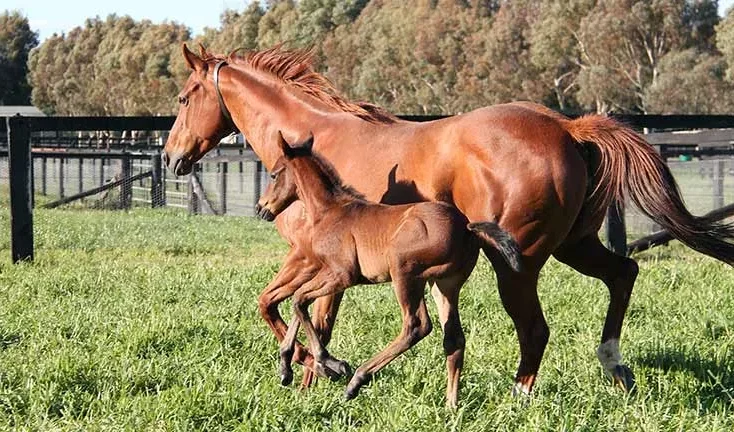
“Stud Masters should know their fertility figures for comparison” said Dr Kevin J Doyle MVB, “as Stud Book figures show fertility our broodmares have decreased as low as 59%.”
With the Australian Stud Book releasing statistics on 1 January 2025, it states the Returns for Live Foal Born in 2023 were 11,481, a drop to 59% on the on the Live Foals per Coverings.
In 2019 the Returns for Live Foal Born was 13,704 with a 64% Live Foals per Covering, while in 2020 it was 12,854 foals at 65%, 2021 as 12,823 foals at 65%, and 2022 as 13,057 foals at 64%.
“The only major change in broodmare management over this period is the exceptional prophylactic use, or more likely mis-use of Antibiotics and Altrenogest, AB’s and ALGT, and no significant infectious agents or caterpillar involvement have been reported.”
“Between January and June, 55 to 270 days after ovulation, is a faultless time to perform Foetal Sex Determination, and the perfect time for High-Risk Pregnancy Evaluation beyond doubt.”
“If a mare has problems that suggest she is high-risk, then this is the appropriate time to deal with her problem and provide maximum opportunity to carry a normal foal for the full term.”
“Ultrasonography is the common and reliable method of High-Risk Mare evaluation for Placentitis, along with monthly SAA blood test and uterus and placenta thickness measurement.”
“Mares diagnosed with Placentitis must have a post mortem of the placenta after she foals or aborts to confirm that the diagnosis was correct.”
“Foals of high-risk mares, correctly diagnosed with a Placentitis, generally have poor high quality colostrum, and their foals require high quality supplement within 12 hours of birth.”
“If performed immediately after birth to evaluate SAA, most foals born with Placentitis are compromised, and respond well to strict protocol which eliminates foal intensive care.”
“Foetal Sex Determination and High-Risk Evaluation, inclusive of scan and Serum Amyloid A, SAA, blood test, is a total cost of $350, followed by monthly SAA Blood Test and Ultrasounds.”
“Examinations to measure and record the CTUP is at 180, 210, 240, 270 and 300 days with the 5 minute scan costing $200 per test for a total cost for 6 examinations not to exceed $1,500.”
“This careful monitoring maximises the mare’s chances of a successful outcome, and if, or when, an abnormality is encountered a basic fee may have to be increased, while testing can be incorporated with other routine procedures with 30-plus mares in a day.”
Now in 57-years of Equine Practice at Scone in the Hunter Valler, Dr Doyle experienced that pregnancy losses in a large number of mares that he has Foetal Sex Determined between 55-270 days of pregnancy is less than 2% per annum over the past 25 years.”
“98% of mares I scanned for foetal sex produced a normal live foal at term, all had normal pregnancies with a normal CTUP measurement of the normal 5mm to 17.5mm thickness.”
“Mares with Placentitis have a CTUP that is less than 17.5mm in thickness and an elevated SAA, while a normal SAA and a normal CTUP mare do not require empirical use of AB’s and ALGT.”
“Accurate and early detection is vital for effective treatment to produce a favourable outcome, namely, to prevent abortion and delay premature labour – AB’s, ALGT and Anti-inflammatories are the optimal treatment if there is an elevated SAA and increase CTUP for these mares.”

FREE BETS – Claim $1000’s in Bonus Bets at the TOP Betting Sites
We take a look at the BIGGEST and BEST Free Daily Racing Offers and Betting Promotions from Australia’s leading online...

Winx delivers third foal at Coolmore Stud
Winx was three weeks overdue but there were no complications with the birth. Debbie Kepitis, a part-owner of Winx, told...

27/9/2026 Horse Racing Tips and Best Bets – Caulfield, Manikato Stakes day
A bumper nine event program has been set down for Caulfield this Sunday, headlined by the Manikato Stakes. The weather...

26/9/2026 Horse Racing Tips and Best Bets – Rosehill, Golden Rose day
A bumper ten event program has been set down for Rosehill this Saturday for Golden Rose Day. The weather is...

26/9/2026 Horse Racing Tips and Best Bets – Mornington, RM Ansett Classic day
Mornington is where Melbourne metro racing heads to this Saturday. The weather is fine, the track is good (4) and...

26/9/2026 Horse Racing Tips and Best Bets – Toowoomba, Toowoomba Weetwood day
A bumper ten event program has been assembled for Toowoomba this Saturday. The weather is fine, the track is good...

New Betting Sites Australia + Top List Bookmaker Apps $$$
Betting in Australia has never been more popular thanks to a large increase in new betting Agencies and Apps available...

Australian Bookmaker Reviews – Online Bookie Ratings $$
Which bookmaker should you bet with? We Review each of the leading online Australian Bookmakers and rate them in order...

Top 10 – Funniest Race Horse Names
Horse racing. Known as the ‘Sport Of Kings’, an industry worth billions, a very serious business…but to some, it’s a...

Melbourne Cup
The Melbourne Cup always approaches fast, with the 2026 edition commencing at 3pm, Tuesday 4th November. The race that stops...

Golden Rose
The is a sprint race held at in New South Wales each year. The () boasts a total prize pool...

Toowoomba Cup
The is a race held at in Queensland each year. The () boasts a total prize pool of and is...

Manikato Stakes
The is a race held at in Victoria each year and is the one of the premier races of the...
Racing Offers
Featured News


Betting News