



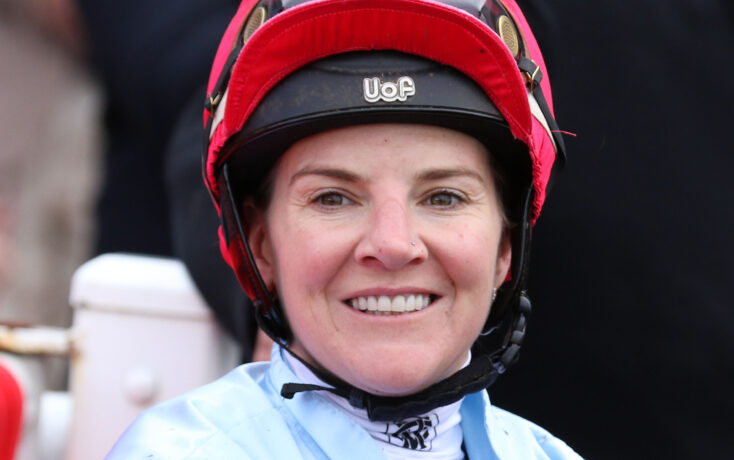
The physical consequences of a fall suffered at Ipswich on July 3 have already kept Nikita Beriman out of the saddle for twenty-nine days, and the severity of her suffering is underlined by the fact that it will be at least another six weeks before any further concussion assessment will be made with regard to when she might be able to resume race riding.
Using the term ‘suffering’ is not an exaggeration. The particular effects of Beriman’s concussion have been both damaging and debilitating to a disturbing and distressing degree … disturbing because of the way the whole matter unfolded at the outset and distressing because of the open-ended nature of the beast which means nobody can say with any certainty when everything will return to normal for Beriman.
That’s a heavy cloud to live under.
“I lost my speech. My eyes are struggling. I have no balance,” explained Beriman. “It affects you psychologically as well. That plays a massive role. Yeah … it is hard.”
It is even harder when you thought the fall had been a harmless one and that, once you had dusted yourself off, you were good to go … and that was the case with Beriman, who was cleared to continue riding at the very next meeting following the Ipswich incident, which was on a Thursday. Beriman, in fact, brought home a winner at the following Saturday meeting without feeling any effects from the fall … but, on that Saturday evening (July 5) everything changed for the worse.
With hindsight, there can be obvious concerns about how things unfolded over that forty-eight hour period following the fall, but Beriman’s own play-by-play account of what happened, not only puts things in the proper perspective, but also shows just how difficult a problem concussion is for those trying to identify, contain and manage it.
“How could they stand me down then when I passed every medical test. They couldn’t stand me down,” stated Beriman, “because I was checked out and I passed everything … I didn’t have any concussion symptoms whatsoever … so it is not anyone’s fault that I was cleared to ride.
“I felt fine, and I was fine. I drove home from Ipswich back to the Sunshine Coast. I did my concussion tests and I was completely fine … but then just to go downhill like that, after the fact, it staggers me that the symptoms can take so long to come to the surface.”
After being taking ill on that Saturday night, there would be no early relief for Beriman. Instead, the opposite was true as both the intensity and the number of symptoms of concussion increased.
“The symptoms didn’t all arrive together,” explained Beriman. “They basically arrived one at a time over pretty much the next week-and-a-half. I can speak now, but I lost my speech. I was slurring my words and couldn’t put a sentence together. I couldn’t move properly … and all of those things like that came later … well after the fall itself.
“Common everyday things that I had no problem with the day before … and then the next day I was in trouble.
“That’s why I have said that I think the mandatory stand-down period for a head knock should be twenty-one days. I do understand that twenty-one days is a long time in racing … I get that … but I’d rather lose twenty-one days than go through what I am going through now.
“Look, prior to this fall I would have been dead against a mandatory twenty-one day stand-down … dead against it … but, now that this has happened to me, you know, I am trying to help get a policy put in place that could possibly help prevent people from going through this … as opposed to what, getting symptoms late and maybe struggling for another six months.
“The twenty-one days should be enough to bypass any doubts. You know stewards could look at the race video and be in no doubt that a rider has suffered a head knock and should be stood down and then the medical tests clear that rider of concussion at the time.
There are no right or wrong answer in that. It is just such a grey area. It’s really tricky.
‘Stewards can’t and wouldn’t want to overrule the medical advice … and neither would anyone else for that matter. I respect the medical knowledge and advice. My concern is that I now know from personal experience how quickly things can change and looking at how that might be taken into account moving forward.
“Unfortunately, there are things we will never know, but I still ask myself the question … even though I passed all of those tests, did riding at the very next meeting have anything to do with the symptoms that I experienced later?
“I had eight rides that day. Did I upset my brain by shaking it? Did it just take for me to wobble my head the wrong way?
“I’m trying to do research on the subject, but it’s a bit slow because my brain can’t process things so well at the moment.
“I am learning along the way though … the hard way … and I think we have all got a lot to learn.
“I knew nothing about concussion before the fall. At very least it would be a good idea for riders to educate themselves on the subject.”